Showing posts with label squawk. Show all posts

Friday, March 25, 2011

Spider Golems

In the Squawk Role-Playing Game, golems are artificial life forms created as robot-like servants by intelligent dinosaurs.
Just as humans build anthropomorphic robots that look like people, so intelligent dinosaurs might make dinosaur-like golems. These golems are based on spider biology, but they have reptilian skin, legs that jut downward from the body like a dinosaur, and pedipalps modified into arms with grasping claws.
Of course a spider golem doesn't have to be shaped like a spider. The shaggy spider golem on the left has four legs. One of the missing legs has been replaced by a circular attachment point for modular biomechanical components.

The golem in the middle has a more conservative spider shape, and a hard mechanical-looking cuticle. The pin joints of each limb have been modified into stronger hinge joints which can support more weight. Standing next to it is a furry insect-based golem with a dinosaur-like body plan.

Dinosaur Sketches

I have been scanning in some drawings, and found a few dinosaurs that I like:

The shading shows some loose skin on this sauropod.

This is some sort of lightly built therizinosaurid, perhaps Erlikosaurus. While most dinosaurs held their spines horizontally, parallel to the ground, the therizinosaurs held their backs up at an angle from the ground.

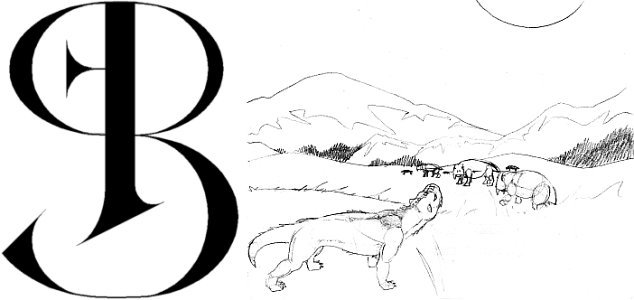
This is a speculative creature that evolved in the Squawk Role-Playing Game universe. In the millions of years since hadrosaurs and other giant dinosaurs disappeared from our world, mammals have evolved from squatty short-limbed critters into a variety of descendants, including graceful forms like deer and wolves. In the Squawk universe dinosaurs have also evolved long-limbed, graceful forms like this hadrosaur.

Friday, February 25, 2011

Squawk Campaign: Chapter 1

I am running a campaign of the Squawk RPG with my D&D group. Each player started out with one of the example characters:
  • Gao Choy - a titan swordsman from Peleg
  • Orgraff - a behemoth butcher from Peleg
  • Foi Shin - an aeolyte alchemist from Peleg
  • 992 - a skand clone mercenary from the Lower Worlds
  • Hammerdrum - a myrmidon mutualist from Trydeen
After a nasty gunfight with space pirates that left their mobile space habitat badly damaged, Gao Choy and Orgraff rescued Foi Shin, 992, Hammerdrum and the myrmidon's students, then commandeered a captured pirate stealth fighter.

Gao Choy maneuvered the stealth fighter into a transfer orbit that brought the stealth fighter to Midgard's L5 lagrange point, where the binary dwarf planets Radix and Monopolis orbit each other. There they met the helpful but cagey stygian Captain Gabriel, who pilots a huge vessel crewed by insectoid golem servants. After dropping dark hints about the Monopolis Trading Company, Gabriel left our heroes with the suggestion that they visit his homeworld (asteroid CMX-5 near L4.)

At Ariel University

After descending to the surface of Radix via beanstalk (space elevator) the crew found themselves stranded at a train platform in the middle of a stampede of Triceratops and Edmontosaurus. One particularly nasty male Triceratops managed to knock the platform off it's foundation, crushing 992 who was using the platform for cover. Fortunately everyone managed to recover from their injuries with the help of Foi Shin's alchemy and Orgraff's unusual tribal healing techniques.

The passengers who were rescued by the team's brave defense of the train platform included the mysterious strix scholar Skreel and his myrmidon protege Chainstorm. Chainstorm recruited the party to help them provide security during Skreel's debate with the silver tongued gremian Commander Spriley at the university amphitheater. Commander Spriley presented a popular theory that each living species was created by intelligent machines, while Skreel defended the "tree of life" tradition which claims that all living things descended from a common ancestor.
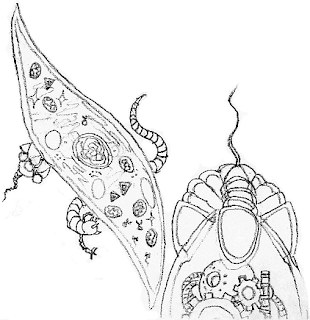
At the end of the debate things got nasty as Commander Spriley's gun thugs converged on Skreel, but our heroes helped chainstorm fight off the commander and his minions. Skreel suggested that it would be expeditious to leave Radix and Monopolis before the commander's fellow Trouble Shooters decided to investigate the incident. Using his Symbiotic Order and Tomb Keeper connections, Skreel arranged for the entire crew to travel with him to Peleg and drop to the surface of that world in a disposable vehicle.

On the way to Peleg

In transit, 992 discussed the disturbing implications of Commander Spriley's theory with Skreel. As a clone, 992 is a product of technology, but if Spriley's theory is right, then all living things are just machines created by other machines. Complicating things, in spite of archeological evidence for technology that dates back thousands of years, there is no evidence for the common descent of species in the Abaddon system.
Skreel then explained that his study of the ancient scriptures and archeology of the Middle Worlds suggest that life in the Abaddon system came from distant stars, and millions of years of fossil evidence may be scattered around the universe. Skreel also quoted an ancient cosmological text which claims that all carbon and other heavy elements that make up both machines and living things was produced by the stars themselves going through cycles of life, death and birth that last for millions of years.
Sunday, December 12, 2010

Squawk Role-Playing Game

The Squawk Role-Playing Game that we have been working since the mid-90's is finally available as a book from CreateSpace and Amazon.com or as a PDF from RPGNow and DriveThruRPG.

See the Game Arts Guild Press Release for details.

Tuesday, March 17, 2009

Intelligent Designs

I have uploaded some pictures of the intelligent species along with theories about their origins - specifically their own theories in their own words. One theory based on religious tradition claims that all living things share a common ancestry while the other theory - based on information available to scientists in the Squawk setting - is skeptical about this claim and suggests that complex machines like animals were probably created by simpler machines.

More pictures and controversy...

Friday, December 26, 2008

Squawk Renaming

Within the last year we have changed the naming conventions in the Squawk Role-Playing Game. Many creatures including the intelligent reptilian species of the Squawk setting were often named after well-known monsters from mythology. The new names are designed to be less confusing:
  • Aeolytes, named after Aeolus, ruler of the winds in greek mythology, used to be called rocs.
  • Behemoths, who get their name from the bible (Job 40, suggesting the largest and most powerful animal,) used to be called ogres.
  • Boreans, named after Boreas, the cold north wind from greek mythology, used to be called orcs.
  • Dromes, from a latin root which suggests running, used to be called basilisks.
  • Gafflings, whose name suggests a gaff or hook, used to be called hobgoblins.
  • Gremians, from an English name meaning "enrages", used to be called gremlins.
  • Gygeans, from the Ring of Gyges described in Plato's Republic (which made it's wearer invisible,) used to be called gargoyles.
  • Leviathans, who get their name from the bible (Job 41, suggesting a giant sea creature,) used to be called draconians.
  • Lyndwyrms, whose name suggests lindworm (a wingless bipedal dragon in British heraldry,) used to be called minotaurs.
  • Myrmidons, named for a tribe commanded by Achilles in greek myth and whose name meant "ant-people", used to be called manticores.
  • Orns, from a root word suggesting birds, used to be called gryphons, cockatrices or harpies.
  • Phages, from hematophagy (blood-eating), used to be called vampires.
  • Skand, from the root of words like "ascend" and "descend" (suggesting leaping and climbing,) used to be called kobolds.
  • Strix, from a bird in roman legends that fed on human flesh and blood, used to be called elves.
  • Stygians, from the river Styx which separated Earth from Hades in greek mythology (also used in words like stygofauna to suggest underground water,) used to be called trolls.
  • Titans get their name indirectly from the titans of greek mythology through the english word titanic, suggesting largeness.
  • Zephyrs, named after Zephyrus, the west wind in greek mythology, used to be called unicorns.

Zephyr

In the Squawk Role-Playing Game, zephyrs are small intelligent hadrosaurs with a single ridged horn as a crest. Originally they were conceived as furry creatures with a zebra-like mane and stripes.

However, we have extensive information about the skin of some hadrosaurs like the "trachodon mummy" discovered in 1908. The interesting skin of real-life hadrosaurs is covered in fine scales with patterns, wrinkles and variations that suggest how the creatures might have been colored in life. Hadrosaur species also had distinctive frills running down their backs.

Inspired by the skin impressions of these and other herbivorous dinosaurs, we have redesigned the zephyr to have smooth skin covered in tiny non-overlapping scales and a "mane" which is actually a frayed dorsal frill.

More pictures and information about zephyrs...

Titan

In the Squawk, Role-Playing Game, titans are huge armored dinosaurs related to ankylosaurs. Titans are one of the newest intelligent species in Squawk, designed by my brother Ulrich, who also produced this image.

More pictures and information about titans...

Stygian

In the Squawk Role-Playing Game, stygians are flightless pterosaurs adapted for swimming. Like beavers, stygians are builders, creating dams and other structures to modify their freshwater habitats. Like platypus, stygians have and electrically sensitive snout used to navigate and find prey in dark and murky places.

More pictures and information about stygians...

Thursday, December 18, 2008

Strix

In the Squawk Role-Playing Game, strix are intelligent primitive birds with raptorial beaks and talons.
More pictures and information about strix...

Tuesday, December 16, 2008

Skand

In the Squawk Role-Playing Game, skands are small intelligent predatory dinosaurs.

Thursday, December 11, 2008

Phage

In the Squawk Role-Playing Game, phages are pterosaurs that drink blood, similar to vampire bats. Pterosaurs are flying reptiles, probably archosaurs, with leathery wings. Pterosaurs look a bit like their bird cousins and and a bit like their more distant bat relatives, but they also have unique features including wings supported by a single elongated finger instead of the four-fingered wings of bats or the fused hands of birds.

Vampire bats are not the only real-life animals that feed on blood. Many invertebrates also practice hematophagy, including mosquitoes, some worms and most leaches. So do some lampreys and even a bird called the oxpecker. Although we don't know of any actual blood eating pterosaurs, Mark Witton and Darren Naish's Azhdarchid Paleobiology research challenges the stereotype that all pterosaurs lived by fishing and scavenging like modern shorebirds.

More pictures and information about phages...

Orn

In the Squawk Role-Playing Game, orns are flightless primitive birds. This is the third intelligent species we designed for Squawk (after gafflings and myrmidons) and the first which was not based on a creature from one of our earlier RPGs.

(Drawing by my brother Ulrich.)

The original orn was a bird- headed humanoid called the "harpy." Next came the "gryphon" and "cockatrice" which were sometimes giant archaeopteryx- like creatures and sometimes feathered crocodiles.

Finally we settled on an idea that combines some of all those ideas, an anthropomorphic primitive climbing bird with a long flexible body (perhaps similar to the narrow-bodied, four-winged fossil bird relative Microraptor gui.)

More pictures and information about orns...

Thursday, December 4, 2008

Myrmidon

In the Squawk Role-Playing Game, Myrmidons are intelligent ceratopsian dinosaurs. They are also the second intelligent species we designed for Squawk (after gafflings.)

Tuesday, December 2, 2008

Lyndwyrm

In the Squawk Role-Playing Game, Lyndwyrms are intelligent theropod dinosaurs with massive horns and shaggy manes. Lyndwyrm horns are inspired by the horns of Carnotaurus, but they are much longer and twisted like the horns of Triceratops.

(The lyndwyrm images above were modeled and rendered with Blender by my brother Ulrich.)

The feathery mane is inspired by the primitive plumage of real life dinosaurs such as Dilong paradoxus, which are thought to be close relatives of Tyrannosaurus rex. We don't know for sure whether the direct ancestors of T. rex had feathers. If some of them did, then it is likely that T. rex itself had some feathers.

More pictures and information about lyndwyrms...

Friday, November 28, 2008

Leviathan

In the Squawk Role-Playing Game, Leviathans are intelligent crocodilians. Like crocodiles and Alligators, leviathans are armored, swimming predators, but Leviathans have longer and more powerful legs, allowing them to walk bipedally like some crocodilian ancestors.

Leviathans are closely related to gygeans, another species of intelligent crocodilians in Squawk. Leviathans are much more robust than their stealthy cousins, with stocky bodies, thick tails, compressed snouts and short but still heavily muscled arms.

More pictures and information about leviathans...

Thursday, November 27, 2008

Gygean

In the Squawk Role-Playing Game, gygeans are intelligent crocodilians with the ability to change skin color and pattern rapidly like octopus, squid and cuttlefish. In spite of the difficulty of depicting this ability in action, Gygeans are one of our most illustrated Squawk species.

Two gygean features are coincidentally found in that other dinosaur science fiction franchise, Jurassic Park. The late author of the Jurassic Park books, Michael Crichton, hints in the original novel that the velociraptors have some active camouflage ability like a chameleon. (In real life, velociraptors were covered in feathers like a bird.) In the second book he gives the Carnotaurus an even more dramatic camouflage which makes them nearly invisible when they hunt at night.

In the movie adaptation of Jurassic Park, Steven Spielberg gives the Dilophosaurus a neck frill which can be erected. This feature is present in the real-life Frilled Dragon and some of the Squawk gygeans. The creators of the movie knew that the real life Dilophosaurus almost certainly did not have this frill (or the ability to spit poison) but including these features in their fictional dinosaurs is an homage the revelations that come as we learn more about prehistoric life.

More pictures and information about gygeans:

Thursday, November 20, 2008

Gremian

In the Squawk Role-Playing Game, Gremians are highly derived deinonychosaurs related to gafflings. They have completely lost most of the distinctive features of their close relatives: sickle claws, feathers and even the long tail. They have developed a relatively enormous head with a shortened snout and a more erect posture.

Some of these adaptations are examples of paedomorphosis, where adults of the species retain features from earlier stages of development. Superficially, gremians resemble avian hatchlings with their bare pinkish skin and huge heads.

More pictures and information about gremians...

Wednesday, November 19, 2008

Gaffling

In the Squawk Role-Playing Game, Gafflings are intelligent deinonychosaurs whose three-fingered hands have exceptional flexibility and opposable thumbs.

Gafflings are the original Squawk species. We designed these creatures (formerly known as "raptors" or "hobgoblins") for an earlier series of RPGs called The Dark Woods or Metazoica, and the Dinosaurs with Swords idea that eventually became Squawk grew out of this idea of an intelligent feathered velociraptor.

More pictures and information about gafflings...

Thursday, November 13, 2008

Drome

In the Squawk Role-Playing Game, dromes are intelligent theropod dinosaurs. Several drome features suggest that they are primitive theropods like Eoraptor, Herrerasaurus, Coelophysis or Dilophosaurus, and not bird-like coelurosaurs like Tyrannosaurus, Velociraptor and modern birds:

Dromes have a narrow ribcage instead of a broad, bird-like bellows. This suggest an aerobic metabolism somewhere in-between a normal "reptilian" and avian system. They have skinny legs and relatively small hips instead of thickly muscled thighs. Dromes have four fingers on each hand, and they are covered in scales instead of feathers. (So far only ceolurosaurs have been discovered with feathers.)

More pictures and information about dromes...