Dromaeosaurs are those sickle clawed "raptor" dinosaurs which have become contenders for scariest dinosaurs in popular imagination (in spite of their modest size) thanks to Jurassic Park.
If you know your dromaeosaurs, you probably thought those "velociraptors" in Jurassic Park were a tad on the big side. That's because they are actually supposed to be Deinonychus, a man-sized dromeosaur species which Greg Paul had classified as a subspecies of Velociraptor for a while. You can see this in Paul's excellent dinosaur art/science book Predatory Dinosaurs of the World (
hardcover and
paperback versions available at Amazon.com.) Since writing that book, Greg Paul has concluded that Deinonychus is actually a separate species after all. (The Jurassic Park Deinonychus are still much bigger than they should be, but the dromaeosaur Utahraptor actually was that big.)
Jurassic Park's "raptors" inherited another mistake which was common for dinosaur artists and scientists at the time: the wrists are broken. The palms of predatory dinosaur hands face inward, not backward, with the "thumbs" pointing forward - like the wrists of a bird or like our hands when we climb a rope, but not when we climb a ladder. I was at the "Collossal Fossils" exhibit at the Pacific Science Center recently and all of the predatory dinosaurs had their wrists the wrong way. When you look at the bones up close you can see how this just doesn't work.
When I saw Jurassic Park for the first time, I was a bit disappointed that they didn't have any feathered dinosaurs. They used the Greg Paul's new classification scheme, and his ridiculously fast Tyrannosaurus, but left out his feathered dromaeosaurs! Paul illustrated all of his small dinosaurs with downy "protofeathers" and gave the dromaeosaurs wing feathers. We don't know if all of the small dinosaurs had feathers, but last month Alan Turner, Peter Makovicky and Mark Norell described
direct physical evidence for flight feathers on the forearms of Velociraptor.
Dromaeosaurs are so closely related to birds, that they might actually be secondarily flightless descendants of the first flying dinosaurs. I recently read Greg Paul's new book on this subject: Dinosaurs of the Air. The new book is more science and less art-oriented than Predatory Dinosaurs of the World. Paul looks at dinosaur metabolism in terms of aerobic excercise (instead of "warm blooded or cold blooded") which allows us to draw conclusions from the bones themselves, and even identify which dinosaurs probably had "in-between" metabolisms.
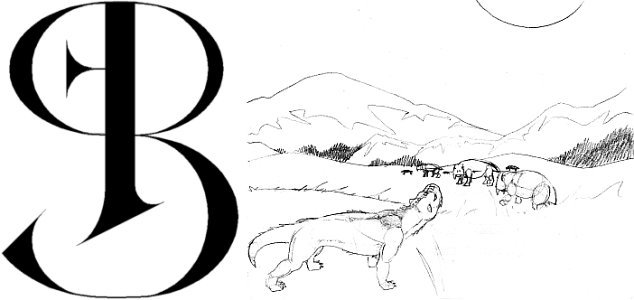
 In the Squawk Role-Playing Game, Gremians are highly derived deinonychosaurs related to gafflings. They have completely lost most of the distinctive features of their close relatives: sickle claws, feathers and even the long tail. They have developed a relatively enormous head with a shortened snout and a more erect posture.

