Showing posts with label dinosaur. Show all posts

Friday, March 25, 2011

Dinosaur Sketches

I have been scanning in some drawings, and found a few dinosaurs that I like:

The shading shows some loose skin on this sauropod.

This is some sort of lightly built therizinosaurid, perhaps Erlikosaurus. While most dinosaurs held their spines horizontally, parallel to the ground, the therizinosaurs held their backs up at an angle from the ground.

This is a speculative creature that evolved in the Squawk Role-Playing Game universe. In the millions of years since hadrosaurs and other giant dinosaurs disappeared from our world, mammals have evolved from squatty short-limbed critters into a variety of descendants, including graceful forms like deer and wolves. In the Squawk universe dinosaurs have also evolved long-limbed, graceful forms like this hadrosaur.

Thursday, November 13, 2008

Drome

In the Squawk Role-Playing Game, dromes are intelligent theropod dinosaurs. Several drome features suggest that they are primitive theropods like Eoraptor, Herrerasaurus, Coelophysis or Dilophosaurus, and not bird-like coelurosaurs like Tyrannosaurus, Velociraptor and modern birds:

Dromes have a narrow ribcage instead of a broad, bird-like bellows. This suggest an aerobic metabolism somewhere in-between a normal "reptilian" and avian system. They have skinny legs and relatively small hips instead of thickly muscled thighs. Dromes have four fingers on each hand, and they are covered in scales instead of feathers. (So far only ceolurosaurs have been discovered with feathers.)

More pictures and information about dromes...

Thursday, March 6, 2008

The Manticore Corps

In the Squawk Role-Playing Game, Manticores are intelligent ceratopsian dinosaurs. While most ceratopsians, like Psittacosaurus and Triceratops are stocky quadrupeds, Manticores are gracile bipeds with long limbs and very long tails. Manticores lack the long horns of some of the larger ceratopsians, and they have a proportionally longer neck shield than any other ceratopsian.
Manticore legs are adapted for running, with only three toes on each foot. The hands are four-fingered manipulators with opposable inner and outer digits. The long tail is a specialized weapon with the tip partially fused into a hard, sharp weapon.
The manticore idea is based on creature ideas from RPGs we made before Squawk. Manticores weren't always dinosaurs (and they weren't always called manticores - the original name was unpronounceable by humans.) The beak is a recent addition to make manticores more like their ceratopsian cousins. As the picture above shows, we have been toying with the idea of giving manticores elongated protective scales.

Saturday, October 27, 2007

Raptor Rapture

Dromaeosaurs are those sickle clawed "raptor" dinosaurs which have become contenders for scariest dinosaurs in popular imagination (in spite of their modest size) thanks to Jurassic Park.

If you know your dromaeosaurs, you probably thought those "velociraptors" in Jurassic Park were a tad on the big side. That's because they are actually supposed to be Deinonychus, a man-sized dromeosaur species which Greg Paul had classified as a subspecies of Velociraptor for a while. You can see this in Paul's excellent dinosaur art/science book Predatory Dinosaurs of the World (hardcover and paperback versions available at Amazon.com.) Since writing that book, Greg Paul has concluded that Deinonychus is actually a separate species after all. (The Jurassic Park Deinonychus are still much bigger than they should be, but the dromaeosaur Utahraptor actually was that big.)

Jurassic Park's "raptors" inherited another mistake which was common for dinosaur artists and scientists at the time: the wrists are broken. The palms of predatory dinosaur hands face inward, not backward, with the "thumbs" pointing forward - like the wrists of a bird or like our hands when we climb a rope, but not when we climb a ladder. I was at the "Collossal Fossils" exhibit at the Pacific Science Center recently and all of the predatory dinosaurs had their wrists the wrong way. When you look at the bones up close you can see how this just doesn't work.

When I saw Jurassic Park for the first time, I was a bit disappointed that they didn't have any feathered dinosaurs. They used the Greg Paul's new classification scheme, and his ridiculously fast Tyrannosaurus, but left out his feathered dromaeosaurs! Paul illustrated all of his small dinosaurs with downy "protofeathers" and gave the dromaeosaurs wing feathers. We don't know if all of the small dinosaurs had feathers, but last month Alan Turner, Peter Makovicky and Mark Norell described direct physical evidence for flight feathers on the forearms of Velociraptor.

Dromaeosaurs are so closely related to birds, that they might actually be secondarily flightless descendants of the first flying dinosaurs. I recently read Greg Paul's new book on this subject: Dinosaurs of the Air. The new book is more science and less art-oriented than Predatory Dinosaurs of the World. Paul looks at dinosaur metabolism in terms of aerobic excercise (instead of "warm blooded or cold blooded") which allows us to draw conclusions from the bones themselves, and even identify which dinosaurs probably had "in-between" metabolisms.

Thursday, October 25, 2007

Hobgoblin vs. The 'Roid

In the Squawk RPG, a hobgoblin is an intelligent dromaeosaur. The basic body plan is like other dromaeosaurs, but the flexibility of the hand and arms is increased and a much larger brain gives the skull a bulbous, rounded shape.


  1. (top left) street-fighter with feet and hands wrapped
  2. (top right) armored with saber and wing-shaped sheild
  3. (middle) soldier with helmet and revolver bayonets
  4. (bottom left) bioarmor with rockets and arm cannons
  5. (bottom right) wizard? on fire!?
I like this series of sketches because it gives the basic concept of the Squawk setting at a glance. The hobgoblin at the top left has his hands in the "broken wrist" orientation from Jurassic Park - which might be easier for hobgoblins than other dromaeosaurs, but isn't the most natural position.

The hobgoblin's "conservative" shape - very similar to the real-life dromaeosaurs - is in part a reaction to Dale Russel's dinosauroid. Dromaeosaurs are already big-headed bipeds with grasping hands, so the dinosauroid's human-like body shape is mostly superfluous. See my gremlin post for more information.

Monday, July 16, 2007

Avoid the 'Roid

In the Squawk Role-Playing Game, a gremlin is an intelligent primitive bird or bird-like dinosaur without feathers. Gremlins have one of the proportionally largest brains of all the intelligent species, but they are one of the smaller species.

Large eyes with cat-like pupils give gremlins excellent vision in a wide range of lighting conditions. Gremlins have a limited sense of smell because of their short snouts. They have only three fingers on each hand (a thumb and two other fingers), but each touch-sensitive soft-tipped finger is both strong and dextrous. A vertical spinal column and modified shoulders give them an improved range of arm motion as well as balancing the brainy skull.

(The narrow hips of the floating gremlin above is a degenerate condition related to living in low gravity. Most gremlins have wide hips which form the round bottom half of an egg-shaped torso.)

Gremlins are plantigrade - they walk on their heels. This helps their vertical posture, but they have very long feet and run with all of their weight on a single toe. This is similar to the way humans run, but more extreme. Gremlins have one other toe which helps them balance while standing and walking. The inside toe - which is often adapted as a sickle-claw or reversed and elongated for perching in other birds and bird-like dinosaurs - is completely absent in gremlins.

Gremlins are partly inspired by paleontologist Dale Russel's speculative "Dinosauroid". Zoology blogger Darren Naish has proposed a much better candidate for super-intelligent dinosaur ancestor and surreal artist Nemo Ramjet has provided a nice illustration.

Wednesday, June 13, 2007

Reading between the Lines

I have been introducing myself to the Ruby programming language. You can try Ruby with this interactive console that runs in your browser. Ruby is a little different from Python, but it seems to be in the same class when it comes to getting work done instead of mucking about in Java or C++.

I have been touching up more mechanical-pencil-on-lined-paper drawings. This was originally from The Dark Woods, a predecessor of the Squawk role-playing game. The character on the right was a "seuss" - a vagely dog-like humanoid race with short noses and long ears. I have removed the ears so hopefully he can pass as a Squawk gremlin. This was the most difficult line-removal project so far because I had to grab samples of blue lines from all over the picture. On some of other lined-paper drawings I may have to grab the blue with the dropper tool and draw in the blue lines manually.

This comparison of predatory dinosaurs I drew about 12 or 13 years ago is strongly influenced by Greg Paul's Predatory Dinosaurs of the World. (Perhaps I should say it was more strongly influenced by Greg Paul's book. The influence of this book overwhelms the meager power of superlatives.) This picture contrasts the long, thin bodies and flexible tails of early theropods such as Coelophysis and Dilophosaurus with the compact, barrel-chested bodies and reduced or stiffened tails of dromaeosaurs, phorusrhacids and tyrannosaurs.

This is a speculatively feathered Lagosuchus (from the Latin "rabbit-crocodile" - a great name, but the original specimen is not very good, so it may be replaced by Marasuchus.) Lagosuchus is probably a "dinosauromorph" - a very close relative of dinosaurs. If some dinosaurs and pterosaurs had feathers or fuzzy insulation, perhaps they inherited this feature from a common ancestor, and all of the big scaly dinosaurs descended from small fluffy ancestors.

The Squawk universe has some new animals that are not found on our world. Some have evolved in alien environments and others have been bred or engineered by intelligent species. These hoofed flightless birds are adapted for life on the open plains. The heavy beaks are probably not efficient for delicately plucking seeds and bugs like an ostrich, so perhaps these creatures chop grass or crunch bones.
Monday, June 11, 2007

Do U Has Basilisk?

Sometimes my drawings just don't come out like I plan.

This drawing shows some anatomical details, such as teeth, posture, hips, muscles, and ribs which are hidden in many other Basilisk drawings.

The addition of clothing made this Basilisk a little too anthropomorphic. Notice that the sandals only support the toes and ball of the foot. I gave this Basilisk toe-less socks but Basilisks are runners who might have blunt claws like an ostrich, so they could wear full socks and even shoes with toes.

Here's what the primitive ancestors of the Basilisk might have looked like, and a reconstruction of psittacosaurus with the newly discovered "quills" which are similar to the Basilisk's spines, but longer but have only been found on part of the tail. Notice the similar structures on an iguana (but also notice how the iguana's scales are very different. Overlapping scales like the onese on the iguana's arms - typical of snakes and lizards - have not been found on dinosaurs.) Speaking of Psittacosaurus, Mark Witton has good reasons to think ceratopsians ate more than just vegetables.

Friday, June 8, 2007

The Right to Keep and Arm Bears

In the last 24 hours I've scanned in more than 300 of my old drawings. This one reminds me of a Panserbjørne from the His Dark Materials trilogy - although it was drawn before I'd heard of that series. Speaking of which, the movie is coming out in December!

This saddled ornithomimid dinosaur was drawn with mechanical pencil on lined paper, then colored with colored pencils. To remove the blue lines, I first created a new transparent layer. I used the "divide" blend mode, and copied and pasted a slice of the lines from the original image into the new layer. Then I copied and pasted that slice over and over to cover all of the lines.

Here's some of my favorite Squawk drawings from the last few days of scanning:

Thursday, June 7, 2007

The Dinosaur Game

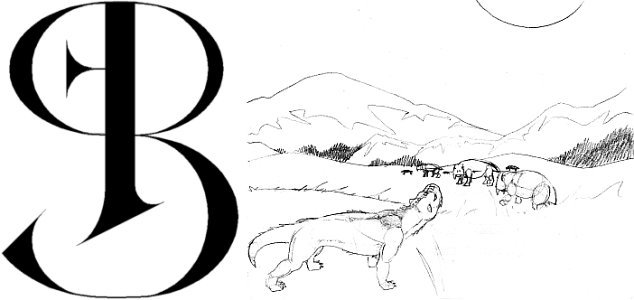
The Dinosaur Game is a Squawk-related side project based on the "playing dinosaurs" games that kids play with their prehistoric animal toys or by imitating the creatures they see on TV. It's just an outline right now, but as I was scanning I discovered a couple of prehistoric scenes from the Permian period (including the image in my logo.) As well as this drawing of a six-limbed predator which I GIMPed into a Pleistocene sabretooth.