Showing posts with label basilisk. Show all posts

Monday, June 11, 2007

Do U Has Basilisk?

Sometimes my drawings just don't come out like I plan.

This drawing shows some anatomical details, such as teeth, posture, hips, muscles, and ribs which are hidden in many other Basilisk drawings.

The addition of clothing made this Basilisk a little too anthropomorphic. Notice that the sandals only support the toes and ball of the foot. I gave this Basilisk toe-less socks but Basilisks are runners who might have blunt claws like an ostrich, so they could wear full socks and even shoes with toes.

Here's what the primitive ancestors of the Basilisk might have looked like, and a reconstruction of psittacosaurus with the newly discovered "quills" which are similar to the Basilisk's spines, but longer but have only been found on part of the tail. Notice the similar structures on an iguana (but also notice how the iguana's scales are very different. Overlapping scales like the onese on the iguana's arms - typical of snakes and lizards - have not been found on dinosaurs.) Speaking of Psittacosaurus, Mark Witton has good reasons to think ceratopsians ate more than just vegetables.

Thursday, June 7, 2007

It blogs!

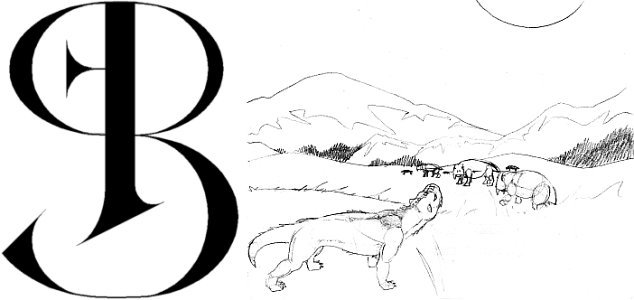
¡Bienvenidos a mi blog nuevo! Kevin, Phillip and I started our How to Draw Squawk jam sessions yesterday. We will be working on one intelligent species from the Squawk role-playing game at a time, and this week we are doing Basilisks. I also scanned in a big stack of old drawings, including the image of Cynognathus stalking Lystrosaurus in my logo.


Basilisks are scaly carnivorous dinosaurs with short tails which stand about 7 or 8 feet tall. They have three-toed feet and four-fingered hands adapted for tool using (with opposable thumbs, reduced claws and more flexibility than most dinosaurs.) A single row of simple hollow quills runs from the top of the Basilisk's head down the back to the end of the tail, similar to the elongated quills on the back of an iguana or Psittacosaurus. Basilisks sport a unique pair of short downward-pointing, backward-curved horns (perhaps technically teeth) near the tip of the jaw, giving them a sort of "chin". The general appearance suggests that Basilisks split early on the dinosaur family tree, and may be closely related to primitive dinosaurs such as Herrerasaurus or even a dinosauromorph like Lagosuchus.
Basilisks should be drawn leaning forward and a bit hunched over compared to human posture, but more vertical than a dinosaur. The tail - although not long - helps counterbalance the body, and the Basilisk is a fast runner who should look ready to take off even when standing still. The quills look like thick stiff hairs or very thin spikes. The Basilisk torso is longer and relatively thinner than more derived, bird-like carnivorous dinosaurs, such as Tyrannosaurus or Velociraptor, so it is okay to give them a somewhat human-like body. Don't forget the long, deep hips to support powerful thigh muscles. Basilisks are carnivores with sharp triangular, slightly recurved teeth. Basilisks should be drawn 9 or 10 heads tall (so the whole character is 9 or 10 times as tall as the height of the character's head if they stand straight up.)