Showing posts with label drawing. Show all posts

Friday, March 25, 2011

Spider Golems

In the Squawk Role-Playing Game, golems are artificial life forms created as robot-like servants by intelligent dinosaurs.
Just as humans build anthropomorphic robots that look like people, so intelligent dinosaurs might make dinosaur-like golems. These golems are based on spider biology, but they have reptilian skin, legs that jut downward from the body like a dinosaur, and pedipalps modified into arms with grasping claws.
Of course a spider golem doesn't have to be shaped like a spider. The shaggy spider golem on the left has four legs. One of the missing legs has been replaced by a circular attachment point for modular biomechanical components.

The golem in the middle has a more conservative spider shape, and a hard mechanical-looking cuticle. The pin joints of each limb have been modified into stronger hinge joints which can support more weight. Standing next to it is a furry insect-based golem with a dinosaur-like body plan.

Dinosaur Sketches

I have been scanning in some drawings, and found a few dinosaurs that I like:

The shading shows some loose skin on this sauropod.

This is some sort of lightly built therizinosaurid, perhaps Erlikosaurus. While most dinosaurs held their spines horizontally, parallel to the ground, the therizinosaurs held their backs up at an angle from the ground.

This is a speculative creature that evolved in the Squawk Role-Playing Game universe. In the millions of years since hadrosaurs and other giant dinosaurs disappeared from our world, mammals have evolved from squatty short-limbed critters into a variety of descendants, including graceful forms like deer and wolves. In the Squawk universe dinosaurs have also evolved long-limbed, graceful forms like this hadrosaur.

Wednesday, July 25, 2007

Freddy vs. Wolverine

Gryphons are one of the first intelligent species we invented for the Squawk Role-Playing Game, but they have settled on their current form only recently. This drawing is a slightly modified version of the original and totally awesome design by my brother Ulrich.

The bird-like appearance is superficial: Gryphons and Gargoyles belong to a fictional group of archosaurs resembling crocodiles with long, flexible, otter-like bodies. (Also in this fictional family are the snake-like guivres.) While Gargoyles became stealthier with naked, color-changing skin, Gryphons became large, powerful, tiger-like predators with huge claws. At some point the Gryphon ancestors aquired insulating pseudo-feathers similar to dinosaurs and pterosaurs, and lost their teeth, so Gryphons rip at their prey with sharp beaks.Gryphons are extraordinarily flexible, moving like a cross between a cat and a snake. All of their joints have a wide range of motion. They can curl up into a ball and wrap around trees. This flexibility helps them to climb, move through tight spaces and crawl through tall ground cover when stalking prey.
At one point gryphons were becoming a less flexible dinosaur design related to archaeopteryx and sickle-clawed dromaeosaurs. In this drawing we can see a combination of archaeopteryx, feathering, anthropomorphic torso and sickle-clawed feet. (It looks like I left an extra toe on one of the feet.) This is totally unlike the current Gryphon idea.

Here is an effort to rehabilitate the same drawing as a modern gryphon with a toothless beak and four huge talons on each foot. The tail, with it's archaeopteryx-like feather pattern, will probably have to go.

Thursday, June 21, 2007

Everybody to the Limit

These were all of the intelligent species of the Squawk role-playing game about a year ago. Since then we have removed a few from the list. Unicorns lacked good art. Harpies were too humanoid. Gryphons and Cockatrices were combined.

This draconian was intentionally anthropormorphized. It's a "teenage mutant ninja Draconian". A more "realistic" draconian would have shorter arms, narrower shoulders and less waist.

"Realistic" renderings emphasize the anatomy of the species and the features that make it unique. Anthropomorphic renderings create characters which are sometimes easier to relate to. (The broad chest sends a message that this draconian is physically powerful.) Squawk creatures in different styles and media and interpreted by different artists give new perspectives, and sometimes lead to improvement in creature designs.

Saturday, June 16, 2007

Draconian

Squawk Draconians are intelligent crocodilians with short snouts, strong legs that allow them to walk bipedally, and short powerful arms with opposeable thumbs. The strange long-snouted creature in the lower right with extra arms is a genetically modified (chimaeric) draconian. Draconians are comfortable both on land and in the water. When they wear clothes, they prefer garments that minimize drag while swimming.

My intelligent crocodile is a strange idea, but there were real crocodile relatives who ran around on long legs, climbed trees, looked like ichthyosaurs or sharks, had short snouts (and ate plants) and even a giant crocodilian filter feeder who caught tiny prey like a baleen whale.

Here are some more Draconians I scanned in recently. My earlier draconian drawings were more anthropomorphic with shorter bodies and longer arms than they should have.


Friday, June 15, 2007

Enter the Dragon

In the Squawk role-playing game, "dragon" is a common name for four-legged predators. Because the big predators in Squawk are archosaurs, most dragons have a classic "reptilian" shape like the crocodile above, and many of them are equally at home in the water or on land.
I like to call this critter the "catoplebas". The forelegs are probably much too long compared to the back legs. Most archosaurs have longer hind legs and higher hips than shoulders. (Obvious exceptions would include high-shouldered sauropods like Brachiosaurus, and some birds.)

Strange as it may seem, crocodiles are more closely related to birds than to lizards. Birds are dinosaurs, and some dinosaurs have toothy snouts, long tails, and scaly armor like crocodiles, but it's still hard to see the bird-crocodile connection because (modern) crocodiles are specialized for living in water (a bit like archosaurian otters.)

It's easier to see the kinship between crocodiles and dinosaurs (including birds) when we look at the different ways that crocodiles move. Like lizards, crocodiles can crawl on their bellies, but when crocodiles need to walk a long distance, lift their bodies off the ground or move quickly, they can use the "high walk" and "gallop", which are very different from the ways lizards walk and run. (This video was posted on YouTube by crocodilian.com.)

Wednesday, June 13, 2007

Reading between the Lines

I have been introducing myself to the Ruby programming language. You can try Ruby with this interactive console that runs in your browser. Ruby is a little different from Python, but it seems to be in the same class when it comes to getting work done instead of mucking about in Java or C++.

I have been touching up more mechanical-pencil-on-lined-paper drawings. This was originally from The Dark Woods, a predecessor of the Squawk role-playing game. The character on the right was a "seuss" - a vagely dog-like humanoid race with short noses and long ears. I have removed the ears so hopefully he can pass as a Squawk gremlin. This was the most difficult line-removal project so far because I had to grab samples of blue lines from all over the picture. On some of other lined-paper drawings I may have to grab the blue with the dropper tool and draw in the blue lines manually.

This comparison of predatory dinosaurs I drew about 12 or 13 years ago is strongly influenced by Greg Paul's Predatory Dinosaurs of the World. (Perhaps I should say it was more strongly influenced by Greg Paul's book. The influence of this book overwhelms the meager power of superlatives.) This picture contrasts the long, thin bodies and flexible tails of early theropods such as Coelophysis and Dilophosaurus with the compact, barrel-chested bodies and reduced or stiffened tails of dromaeosaurs, phorusrhacids and tyrannosaurs.

This is a speculatively feathered Lagosuchus (from the Latin "rabbit-crocodile" - a great name, but the original specimen is not very good, so it may be replaced by Marasuchus.) Lagosuchus is probably a "dinosauromorph" - a very close relative of dinosaurs. If some dinosaurs and pterosaurs had feathers or fuzzy insulation, perhaps they inherited this feature from a common ancestor, and all of the big scaly dinosaurs descended from small fluffy ancestors.

The Squawk universe has some new animals that are not found on our world. Some have evolved in alien environments and others have been bred or engineered by intelligent species. These hoofed flightless birds are adapted for life on the open plains. The heavy beaks are probably not efficient for delicately plucking seeds and bugs like an ostrich, so perhaps these creatures chop grass or crunch bones.

Tuesday, June 12, 2007

Drawing Xanadu


Xanadu is an island empire on the Squawk world Peleg. The culture of Xanadu is modeled after asian countries such as China and Japan. This drawing was a sketch for a 3D Squawk game we started to develop set in Xanadu. The linear perspective and very limited use of atmospheric depth is more in the tradition of european art than asian art and the clash is akward.

This is a quick sketch for a 2D Squawk game we are beginning to develop. Vertical exaggeration, atmospheric perspective, and orthographic perspective (parallel lines look parallel in the image) give the scene the look of a Chinese ink painting, and lend themselves naturally to a 2D game engine.

The small garden shows how the game might be different from a painting. In a painting the left and right sides of the fence would be at an angle, making it difficult to sort out whether the fence should be drawn in front of or behind each character. In this design the sides of the fence are vertical to make sorting simpler.

This sketch was drawn over and around printed text, which I removed using the GIMP's select-by-color tool, deselecting the parts I didn't want removed, growing the selection by one pixel, and clearing the selected area. If you look closely you can still see the holes where the text was.

This is another sketch for the Squawk 2D game. Four of the five intelligent species of Xanadu (Minotaur, Titan, Kobold, and Gargoyle), a theropod dinosaur ("lyndwyrm") and a sauropod ("behemoth") are shown in size comparison. The interior is shown with orthographic perspective typical of Japanese woodblock prints, and the exterior is shown in a simplified orthographic perspective like the garden above.

Here's a small wooden building with a different type of orthographic perspective, similar to the game Diablo. In a game, this image would be difficult to sort, so it would probably be broken down into parts which would be sorted seperately.

This tower was looking pretty good until I ran out of space at the top :-) The eight sides of the tower are inspired by Chinese pagodas, but also might represent the eight elements of Xanadu's alchemy tradition: water, wood, earth, metal, fire, lightning, air and shadow, or the eight legs of the giant spiders which produce bulletproof spider-silk, the empire's most important product.
I tried to create a more alien style of architecture in this drawing. It's one of my favorites.
Monday, June 11, 2007

Do U Has Basilisk?

Sometimes my drawings just don't come out like I plan.

This drawing shows some anatomical details, such as teeth, posture, hips, muscles, and ribs which are hidden in many other Basilisk drawings.

The addition of clothing made this Basilisk a little too anthropomorphic. Notice that the sandals only support the toes and ball of the foot. I gave this Basilisk toe-less socks but Basilisks are runners who might have blunt claws like an ostrich, so they could wear full socks and even shoes with toes.

Here's what the primitive ancestors of the Basilisk might have looked like, and a reconstruction of psittacosaurus with the newly discovered "quills" which are similar to the Basilisk's spines, but longer but have only been found on part of the tail. Notice the similar structures on an iguana (but also notice how the iguana's scales are very different. Overlapping scales like the onese on the iguana's arms - typical of snakes and lizards - have not been found on dinosaurs.) Speaking of Psittacosaurus, Mark Witton has good reasons to think ceratopsians ate more than just vegetables.

Friday, June 8, 2007

The Right to Keep and Arm Bears

In the last 24 hours I've scanned in more than 300 of my old drawings. This one reminds me of a Panserbjørne from the His Dark Materials trilogy - although it was drawn before I'd heard of that series. Speaking of which, the movie is coming out in December!

This saddled ornithomimid dinosaur was drawn with mechanical pencil on lined paper, then colored with colored pencils. To remove the blue lines, I first created a new transparent layer. I used the "divide" blend mode, and copied and pasted a slice of the lines from the original image into the new layer. Then I copied and pasted that slice over and over to cover all of the lines.

Here's some of my favorite Squawk drawings from the last few days of scanning:

Thursday, June 7, 2007

It blogs!

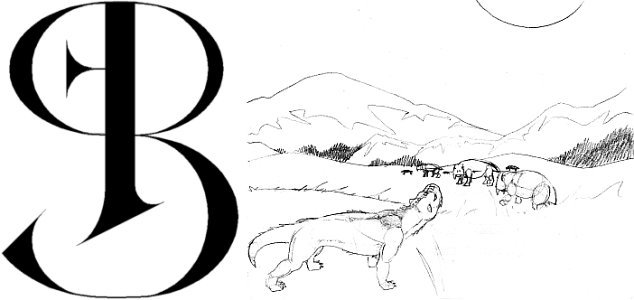
¡Bienvenidos a mi blog nuevo! Kevin, Phillip and I started our How to Draw Squawk jam sessions yesterday. We will be working on one intelligent species from the Squawk role-playing game at a time, and this week we are doing Basilisks. I also scanned in a big stack of old drawings, including the image of Cynognathus stalking Lystrosaurus in my logo.


Basilisks are scaly carnivorous dinosaurs with short tails which stand about 7 or 8 feet tall. They have three-toed feet and four-fingered hands adapted for tool using (with opposable thumbs, reduced claws and more flexibility than most dinosaurs.) A single row of simple hollow quills runs from the top of the Basilisk's head down the back to the end of the tail, similar to the elongated quills on the back of an iguana or Psittacosaurus. Basilisks sport a unique pair of short downward-pointing, backward-curved horns (perhaps technically teeth) near the tip of the jaw, giving them a sort of "chin". The general appearance suggests that Basilisks split early on the dinosaur family tree, and may be closely related to primitive dinosaurs such as Herrerasaurus or even a dinosauromorph like Lagosuchus.
Basilisks should be drawn leaning forward and a bit hunched over compared to human posture, but more vertical than a dinosaur. The tail - although not long - helps counterbalance the body, and the Basilisk is a fast runner who should look ready to take off even when standing still. The quills look like thick stiff hairs or very thin spikes. The Basilisk torso is longer and relatively thinner than more derived, bird-like carnivorous dinosaurs, such as Tyrannosaurus or Velociraptor, so it is okay to give them a somewhat human-like body. Don't forget the long, deep hips to support powerful thigh muscles. Basilisks are carnivores with sharp triangular, slightly recurved teeth. Basilisks should be drawn 9 or 10 heads tall (so the whole character is 9 or 10 times as tall as the height of the character's head if they stand straight up.)