While drawing
Draconians, we started discussing how crocodile skin is textured. Crocodiles are (mostly) covered in non-overlapping "scutes" like dinosaurs, turtles, bird legs, and lizard faces, but different from the overlapping diamond-shaped scales on the bodies of snakes and lizards.

Crocodile faces are actually smooth, without scales, but they do have ridges, bumps and short horns. They have no lips, so the skin of a crocodile's head is pulled tight over it's skull. The skin over the jaw-closing muscle toward the back of the mouth is wrinkled or scaly with the main creases parallel to the jaw and the bottom of the skull. The jaw is faintly scaled (you can barely see the creases) and the throat skin under the jaw has scales arranged in a neat rectangular grid.
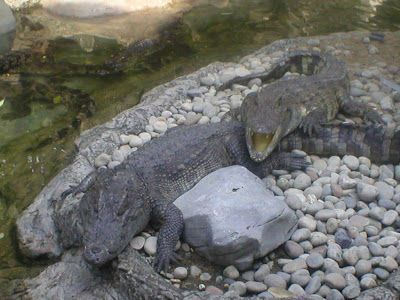
Two prominent ridges on a crocodiles face run from the top of the skull, over the eyes and toward the nostrils. Similar ridges are found on other archosaurs, sometimes enhanced with crests like
Dilophosaurus or horns like
Carnotaurus. The only living dinosaurs - birds - don't have lips or scaly faces, so it's tempting to imagine how dinosaur faces might resemble crocodiles, but Carnotaurus had scales on it's face, and the jury is still out on dinosaur lips (and cheeks.)
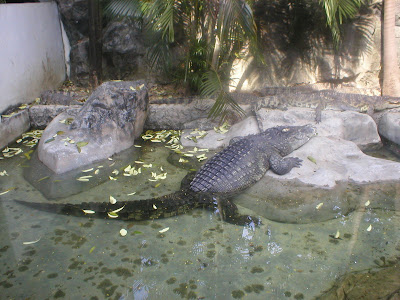
The scales on the crocodile's neck, body and tail follow this neat rectangular pattern, as if the crocodile were divided into short segments (rows) like a worm and each segment was divided into the same number of scales lined up in neat columns running from the head to the tip of the tail. These columns are pinched above the shoulder near the top of each leg as if the columns were pushed apart to make room to insert the front and back legs. The scale pattern is also pinched at the back of the jaw. Irregular areas are filled in with smaller scales.
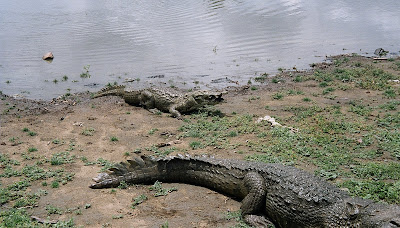
The scales of the back are combined into armored plates which are twice the width of a normal scale, with the creases aligned to every other row of smaller scales. Some of the columns of armor scales have a raised ridge in the middle of each scale. Two rows of ridged scales, starting just over the back legs, have higher and higher ridges, sometimes resembling a pair of fins.
The scales of the side are bumpy and there may be one or two more columns of large, ridged scales on the side, alternating with small bumpy scales. The scales of the belly are smooth.
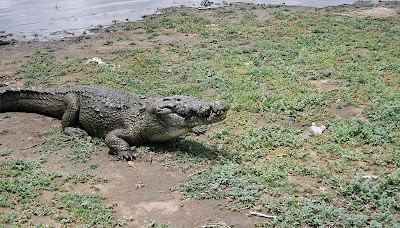
The scales of crocodile limbs are not neatly parallel and perpendicular to the central axis of the limbs. Instead the main segments seem to run through the limbs like slices in the direction of water flowing around the limbs bent at natural zig-zag angles from the body (so the limb bones are 45 degrees one way or the other from the axis of the spine.) The scales of the hands and feet are similar to the pattern seen on birds.
(Images from the
Flickr pages of
liquidindian and
hiyori13 shared with the
Creative Commons Attribution-Sharealike license.)
 These were all of the intelligent species of the Squawk role-playing game about a year ago. Since then we have removed a few from the list. Unicorns lacked good art. Harpies were too humanoid. Gryphons and Cockatrices were combined.
 This draconian was intentionally anthropormorphized. It's a "teenage mutant ninja Draconian". A more "realistic" draconian would have shorter arms, narrower shoulders and less waist.


