Saturday, December 15, 2007

Kobold Bashing

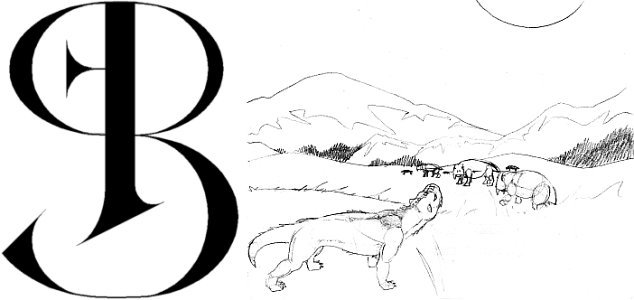
In the Squawk role-playing game, kobolds are intelligent theropod dinosaurs. They are roughly humanoid in shape, except for having four fingers or toes on each limb, a prehensile tail and a typical theropod snout including a mouth full of sharp teeth. Kobolds are tree-climbing predators, with similarities to cats and primates. They are acrobatic and powerfully muscled for their size (about 1.6 m tall.)

The long feathers on the head are a single solid color in males (often black, white, red or yellow, but sometimes other colors) and a more complex pattern of more earthy colors in females. Both sexes have variable patterns of spots and thinner fur-like plumage on the neck, shoulders and other parts of the body.

The picture on the right shows a compact body shape more typical of advanced theropods like allosaurus, tyrannosaurus and velociraptor than the long body and human-like pinched waist of the kobold. When I made this drawing we were working on making some of the most humanoid Squawk species more dinosaur-like. (This was shortly before the discovery of the relatively long-bodied arboreal feathered theropod Microraptor.)

Saturday, October 27, 2007

Raptor Rapture

Dromaeosaurs are those sickle clawed "raptor" dinosaurs which have become contenders for scariest dinosaurs in popular imagination (in spite of their modest size) thanks to Jurassic Park.

If you know your dromaeosaurs, you probably thought those "velociraptors" in Jurassic Park were a tad on the big side. That's because they are actually supposed to be Deinonychus, a man-sized dromeosaur species which Greg Paul had classified as a subspecies of Velociraptor for a while. You can see this in Paul's excellent dinosaur art/science book Predatory Dinosaurs of the World (hardcover and paperback versions available at Amazon.com.) Since writing that book, Greg Paul has concluded that Deinonychus is actually a separate species after all. (The Jurassic Park Deinonychus are still much bigger than they should be, but the dromaeosaur Utahraptor actually was that big.)

Jurassic Park's "raptors" inherited another mistake which was common for dinosaur artists and scientists at the time: the wrists are broken. The palms of predatory dinosaur hands face inward, not backward, with the "thumbs" pointing forward - like the wrists of a bird or like our hands when we climb a rope, but not when we climb a ladder. I was at the "Collossal Fossils" exhibit at the Pacific Science Center recently and all of the predatory dinosaurs had their wrists the wrong way. When you look at the bones up close you can see how this just doesn't work.

When I saw Jurassic Park for the first time, I was a bit disappointed that they didn't have any feathered dinosaurs. They used the Greg Paul's new classification scheme, and his ridiculously fast Tyrannosaurus, but left out his feathered dromaeosaurs! Paul illustrated all of his small dinosaurs with downy "protofeathers" and gave the dromaeosaurs wing feathers. We don't know if all of the small dinosaurs had feathers, but last month Alan Turner, Peter Makovicky and Mark Norell described direct physical evidence for flight feathers on the forearms of Velociraptor.

Dromaeosaurs are so closely related to birds, that they might actually be secondarily flightless descendants of the first flying dinosaurs. I recently read Greg Paul's new book on this subject: Dinosaurs of the Air. The new book is more science and less art-oriented than Predatory Dinosaurs of the World. Paul looks at dinosaur metabolism in terms of aerobic excercise (instead of "warm blooded or cold blooded") which allows us to draw conclusions from the bones themselves, and even identify which dinosaurs probably had "in-between" metabolisms.

Thursday, October 25, 2007

Hobgoblin vs. The 'Roid

In the Squawk RPG, a hobgoblin is an intelligent dromaeosaur. The basic body plan is like other dromaeosaurs, but the flexibility of the hand and arms is increased and a much larger brain gives the skull a bulbous, rounded shape.


  1. (top left) street-fighter with feet and hands wrapped
  2. (top right) armored with saber and wing-shaped sheild
  3. (middle) soldier with helmet and revolver bayonets
  4. (bottom left) bioarmor with rockets and arm cannons
  5. (bottom right) wizard? on fire!?
I like this series of sketches because it gives the basic concept of the Squawk setting at a glance. The hobgoblin at the top left has his hands in the "broken wrist" orientation from Jurassic Park - which might be easier for hobgoblins than other dromaeosaurs, but isn't the most natural position.

The hobgoblin's "conservative" shape - very similar to the real-life dromaeosaurs - is in part a reaction to Dale Russel's dinosauroid. Dromaeosaurs are already big-headed bipeds with grasping hands, so the dinosauroid's human-like body shape is mostly superfluous. See my gremlin post for more information.

Wednesday, July 25, 2007

Freddy vs. Wolverine

Gryphons are one of the first intelligent species we invented for the Squawk Role-Playing Game, but they have settled on their current form only recently. This drawing is a slightly modified version of the original and totally awesome design by my brother Ulrich.

The bird-like appearance is superficial: Gryphons and Gargoyles belong to a fictional group of archosaurs resembling crocodiles with long, flexible, otter-like bodies. (Also in this fictional family are the snake-like guivres.) While Gargoyles became stealthier with naked, color-changing skin, Gryphons became large, powerful, tiger-like predators with huge claws. At some point the Gryphon ancestors aquired insulating pseudo-feathers similar to dinosaurs and pterosaurs, and lost their teeth, so Gryphons rip at their prey with sharp beaks.Gryphons are extraordinarily flexible, moving like a cross between a cat and a snake. All of their joints have a wide range of motion. They can curl up into a ball and wrap around trees. This flexibility helps them to climb, move through tight spaces and crawl through tall ground cover when stalking prey.
At one point gryphons were becoming a less flexible dinosaur design related to archaeopteryx and sickle-clawed dromaeosaurs. In this drawing we can see a combination of archaeopteryx, feathering, anthropomorphic torso and sickle-clawed feet. (It looks like I left an extra toe on one of the feet.) This is totally unlike the current Gryphon idea.

Here is an effort to rehabilitate the same drawing as a modern gryphon with a toothless beak and four huge talons on each foot. The tail, with it's archaeopteryx-like feather pattern, will probably have to go.

Monday, July 16, 2007

Avoid the 'Roid

In the Squawk Role-Playing Game, a gremlin is an intelligent primitive bird or bird-like dinosaur without feathers. Gremlins have one of the proportionally largest brains of all the intelligent species, but they are one of the smaller species.

Large eyes with cat-like pupils give gremlins excellent vision in a wide range of lighting conditions. Gremlins have a limited sense of smell because of their short snouts. They have only three fingers on each hand (a thumb and two other fingers), but each touch-sensitive soft-tipped finger is both strong and dextrous. A vertical spinal column and modified shoulders give them an improved range of arm motion as well as balancing the brainy skull.

(The narrow hips of the floating gremlin above is a degenerate condition related to living in low gravity. Most gremlins have wide hips which form the round bottom half of an egg-shaped torso.)

Gremlins are plantigrade - they walk on their heels. This helps their vertical posture, but they have very long feet and run with all of their weight on a single toe. This is similar to the way humans run, but more extreme. Gremlins have one other toe which helps them balance while standing and walking. The inside toe - which is often adapted as a sickle-claw or reversed and elongated for perching in other birds and bird-like dinosaurs - is completely absent in gremlins.

Gremlins are partly inspired by paleontologist Dale Russel's speculative "Dinosauroid". Zoology blogger Darren Naish has proposed a much better candidate for super-intelligent dinosaur ancestor and surreal artist Nemo Ramjet has provided a nice illustration.

Monday, July 2, 2007

To Write a Post about Gargoyles

This is one of the best re-imaginings of a Squawk race by my brother Ulrich. For our Xanadu setting he re-invented the dragon-like, chameleon-skinned Gargoyle as a long-bodied Japanese dragon anthropomorphized in the tradition of the Teenage Mutant Ninja Turtles. This added more oriental flavor to the Xanadu culture and gave us a memorable look for a race that was not well represented in the artwork.
Gargoyles are able to change the color and pattern of their skin like a chameleon or cephalopod to communicate and disguise themselves. As intelligent creatures they can invent new disguises and stealth techniques. In this drawing we see how individual difference in texture can be exploited to blend in with different environments.
We tried to imagine how a long, low crocodile-like head could contain the large brain of an intelligent species. horns add a hard-edged, squared look to a domed forehead. The entire head is large relative to the body. At some point you have to look past stereotypes (relative brain size is not all-important, some fish and birds have more brain-to-body mass than humans) and accept what just looks cool.
One feature that Ulrich did not dig about gargoyles was the flappy, erectable neck frill, so these have become something of an optional feature - a display organ that is very large in some male gargoyles and absent in females and some males.

Monday, June 25, 2007

I Played Dungeons and Dragons for Three Hours. Then I was Slain by an Elf.

The intelligent species of the Squawk role-playing game are named after creatures from mythology. Squawk Elves are carnivorous flightless birds with long, powerful arms. Elves can catch prey with the retractable talons of their hands and feet, and break bones with their powerful beak, but they are also intelligent hunters who employ strategy and weapons. The elves were once the masters of a multi-planet dynasty based around electrical technology, but now most elves live in small nomadic bands or minority communities among the other intelligent species.My original concept for the elves was a neckless creature with absurdly massive claws. All four feed would be equipped like the right foot in this drawing. This would make them the "Wolverine" or "Freddy Kruger" of the Squawk universe. (Most of the intelligent species seem to be competing for this position, but the current champions seem to be Gryphons.)

My brother Ulrich developed this alternate visualization of Elf anatomy. In this version, the elf stil has a powerful neck, round body, and similarly-proportioned arms and legs with sharp claws, but the length of the claws is less extreme (but more consistent than my drawings) and the neck is long enough for the head to look around.