Wednesday, July 25, 2007

Freddy vs. Wolverine

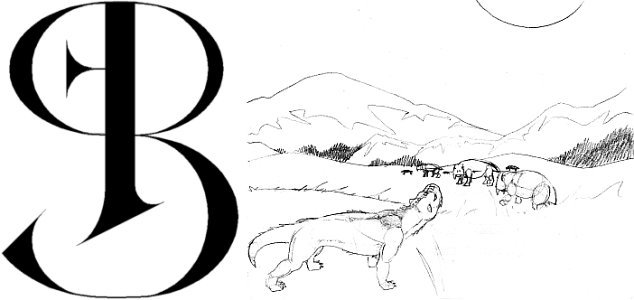
Gryphons are one of the first intelligent species we invented for the Squawk Role-Playing Game, but they have settled on their current form only recently. This drawing is a slightly modified version of the original and totally awesome design by my brother Ulrich.

The bird-like appearance is superficial: Gryphons and Gargoyles belong to a fictional group of archosaurs resembling crocodiles with long, flexible, otter-like bodies. (Also in this fictional family are the snake-like guivres.) While Gargoyles became stealthier with naked, color-changing skin, Gryphons became large, powerful, tiger-like predators with huge claws. At some point the Gryphon ancestors aquired insulating pseudo-feathers similar to dinosaurs and pterosaurs, and lost their teeth, so Gryphons rip at their prey with sharp beaks.Gryphons are extraordinarily flexible, moving like a cross between a cat and a snake. All of their joints have a wide range of motion. They can curl up into a ball and wrap around trees. This flexibility helps them to climb, move through tight spaces and crawl through tall ground cover when stalking prey.
At one point gryphons were becoming a less flexible dinosaur design related to archaeopteryx and sickle-clawed dromaeosaurs. In this drawing we can see a combination of archaeopteryx, feathering, anthropomorphic torso and sickle-clawed feet. (It looks like I left an extra toe on one of the feet.) This is totally unlike the current Gryphon idea.

Here is an effort to rehabilitate the same drawing as a modern gryphon with a toothless beak and four huge talons on each foot. The tail, with it's archaeopteryx-like feather pattern, will probably have to go.

Monday, July 16, 2007

Avoid the 'Roid

In the Squawk Role-Playing Game, a gremlin is an intelligent primitive bird or bird-like dinosaur without feathers. Gremlins have one of the proportionally largest brains of all the intelligent species, but they are one of the smaller species.

Large eyes with cat-like pupils give gremlins excellent vision in a wide range of lighting conditions. Gremlins have a limited sense of smell because of their short snouts. They have only three fingers on each hand (a thumb and two other fingers), but each touch-sensitive soft-tipped finger is both strong and dextrous. A vertical spinal column and modified shoulders give them an improved range of arm motion as well as balancing the brainy skull.

(The narrow hips of the floating gremlin above is a degenerate condition related to living in low gravity. Most gremlins have wide hips which form the round bottom half of an egg-shaped torso.)

Gremlins are plantigrade - they walk on their heels. This helps their vertical posture, but they have very long feet and run with all of their weight on a single toe. This is similar to the way humans run, but more extreme. Gremlins have one other toe which helps them balance while standing and walking. The inside toe - which is often adapted as a sickle-claw or reversed and elongated for perching in other birds and bird-like dinosaurs - is completely absent in gremlins.

Gremlins are partly inspired by paleontologist Dale Russel's speculative "Dinosauroid". Zoology blogger Darren Naish has proposed a much better candidate for super-intelligent dinosaur ancestor and surreal artist Nemo Ramjet has provided a nice illustration.

Monday, July 2, 2007

To Write a Post about Gargoyles

This is one of the best re-imaginings of a Squawk race by my brother Ulrich. For our Xanadu setting he re-invented the dragon-like, chameleon-skinned Gargoyle as a long-bodied Japanese dragon anthropomorphized in the tradition of the Teenage Mutant Ninja Turtles. This added more oriental flavor to the Xanadu culture and gave us a memorable look for a race that was not well represented in the artwork.
Gargoyles are able to change the color and pattern of their skin like a chameleon or cephalopod to communicate and disguise themselves. As intelligent creatures they can invent new disguises and stealth techniques. In this drawing we see how individual difference in texture can be exploited to blend in with different environments.
We tried to imagine how a long, low crocodile-like head could contain the large brain of an intelligent species. horns add a hard-edged, squared look to a domed forehead. The entire head is large relative to the body. At some point you have to look past stereotypes (relative brain size is not all-important, some fish and birds have more brain-to-body mass than humans) and accept what just looks cool.
One feature that Ulrich did not dig about gargoyles was the flappy, erectable neck frill, so these have become something of an optional feature - a display organ that is very large in some male gargoyles and absent in females and some males.

Monday, June 25, 2007

I Played Dungeons and Dragons for Three Hours. Then I was Slain by an Elf.

The intelligent species of the Squawk role-playing game are named after creatures from mythology. Squawk Elves are carnivorous flightless birds with long, powerful arms. Elves can catch prey with the retractable talons of their hands and feet, and break bones with their powerful beak, but they are also intelligent hunters who employ strategy and weapons. The elves were once the masters of a multi-planet dynasty based around electrical technology, but now most elves live in small nomadic bands or minority communities among the other intelligent species.My original concept for the elves was a neckless creature with absurdly massive claws. All four feed would be equipped like the right foot in this drawing. This would make them the "Wolverine" or "Freddy Kruger" of the Squawk universe. (Most of the intelligent species seem to be competing for this position, but the current champions seem to be Gryphons.)

My brother Ulrich developed this alternate visualization of Elf anatomy. In this version, the elf stil has a powerful neck, round body, and similarly-proportioned arms and legs with sharp claws, but the length of the claws is less extreme (but more consistent than my drawings) and the neck is long enough for the head to look around.

Friday, June 22, 2007

Recipe for Disaster

1 can frozen white grape juice concentrate
1 package grape Kool-Aid artificially flavored soft drink mix
water
sugar

Prepare white grape juice and Kool-Aid according to the directions on the can and package. Mix together in a large pitcher. My dad says it's the worst of all the bad combinations of juice and Kool-Aid. I think it takes like Oregon-grape berries. Oregon-grape has a subtle flavor similar to boysenberries with an earthy twist. Unless you pick Oregon-grape berries at the exact moment of peak ripeness they are puckeringly tart.

Thursday, June 21, 2007

Everybody to the Limit

These were all of the intelligent species of the Squawk role-playing game about a year ago. Since then we have removed a few from the list. Unicorns lacked good art. Harpies were too humanoid. Gryphons and Cockatrices were combined.

This draconian was intentionally anthropormorphized. It's a "teenage mutant ninja Draconian". A more "realistic" draconian would have shorter arms, narrower shoulders and less waist.

"Realistic" renderings emphasize the anatomy of the species and the features that make it unique. Anthropomorphic renderings create characters which are sometimes easier to relate to. (The broad chest sends a message that this draconian is physically powerful.) Squawk creatures in different styles and media and interpreted by different artists give new perspectives, and sometimes lead to improvement in creature designs.

Wednesday, June 20, 2007

Dragon Skin

While drawing Draconians, we started discussing how crocodile skin is textured. Crocodiles are (mostly) covered in non-overlapping "scutes" like dinosaurs, turtles, bird legs, and lizard faces, but different from the overlapping diamond-shaped scales on the bodies of snakes and lizards.

Crocodile faces are actually smooth, without scales, but they do have ridges, bumps and short horns. They have no lips, so the skin of a crocodile's head is pulled tight over it's skull. The skin over the jaw-closing muscle toward the back of the mouth is wrinkled or scaly with the main creases parallel to the jaw and the bottom of the skull. The jaw is faintly scaled (you can barely see the creases) and the throat skin under the jaw has scales arranged in a neat rectangular grid.

Two prominent ridges on a crocodiles face run from the top of the skull, over the eyes and toward the nostrils. Similar ridges are found on other archosaurs, sometimes enhanced with crests like Dilophosaurus or horns like Carnotaurus. The only living dinosaurs - birds - don't have lips or scaly faces, so it's tempting to imagine how dinosaur faces might resemble crocodiles, but Carnotaurus had scales on it's face, and the jury is still out on dinosaur lips (and cheeks.)

The scales on the crocodile's neck, body and tail follow this neat rectangular pattern, as if the crocodile were divided into short segments (rows) like a worm and each segment was divided into the same number of scales lined up in neat columns running from the head to the tip of the tail. These columns are pinched above the shoulder near the top of each leg as if the columns were pushed apart to make room to insert the front and back legs. The scale pattern is also pinched at the back of the jaw. Irregular areas are filled in with smaller scales.

The scales of the back are combined into armored plates which are twice the width of a normal scale, with the creases aligned to every other row of smaller scales. Some of the columns of armor scales have a raised ridge in the middle of each scale. Two rows of ridged scales, starting just over the back legs, have higher and higher ridges, sometimes resembling a pair of fins.
The scales of the side are bumpy and there may be one or two more columns of large, ridged scales on the side, alternating with small bumpy scales. The scales of the belly are smooth.

The scales of crocodile limbs are not neatly parallel and perpendicular to the central axis of the limbs. Instead the main segments seem to run through the limbs like slices in the direction of water flowing around the limbs bent at natural zig-zag angles from the body (so the limb bones are 45 degrees one way or the other from the axis of the spine.) The scales of the hands and feet are similar to the pattern seen on birds.

(Images from the Flickr pages of liquidindian and hiyori13 shared with the Creative Commons Attribution-Sharealike license.)